What is the Breakthrough Device Program?
The FDA’s Breakthrough Device Program is a voluntary program to “fast-track” certain medical devices and device-led combination products that provide for more effective treatment or diagnosis in order to further the FDA’s goal of advancing device innovation while protecting public health.
Program participants benefit from more frequent and interactive communication with FDA experts during the premarket review. This includes opportunities such as phase sprint discussions to resolve specific issues quickly, feedback on data development plans, and the ability to obtain agreement on clinical protocols. These interactions can significantly reduce uncertainty and help applicants align early with FDA expectations.
Breakthrough-designated device applications also receive priority FDA review on Q-Submissions, Investigational Device Exemption (IDE) applications, and marketing submissions. While this priority review does not shorten statutory review timelines, it often results in more efficient and predictable review cycles.
What counts as a Breakthrough Device?
According to the FDA, devices subject to premarket approval applications (PMAs), premarket notification [510(k)], or requests for De Novo classification are eligible for Breakthrough Device designation if the device meets both of the following criteria:
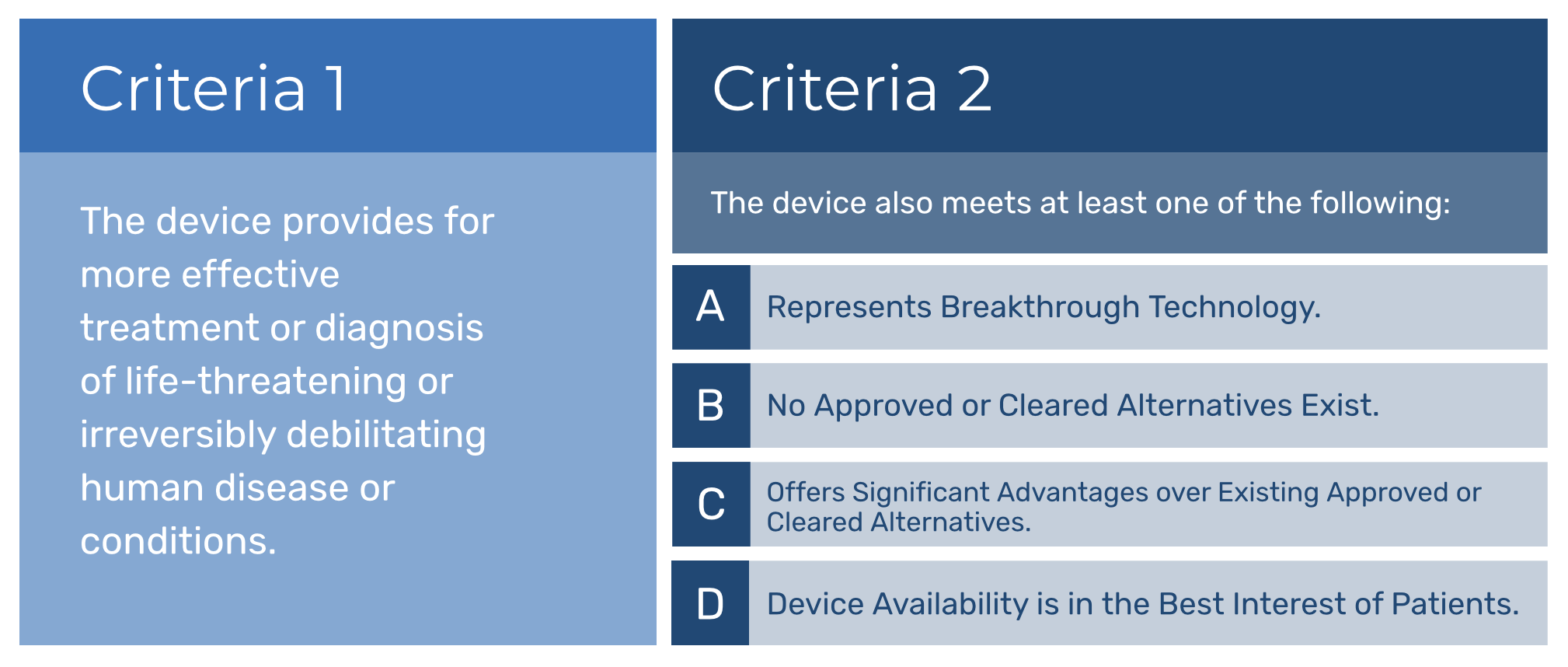
In practice, the strongest applications clearly articulate both clinical significance and unmet need, supported by preliminary data, literature, or a compelling scientific rationale. FDA reviewers will expect a well-reasoned explanation of how the device meaningfully improves upon existing standards of care, not just that the device is a novel technology.
Disqualifiers and Misconceptions
Designation Request for Breakthrough Device does not guarantee acceptance, even if the product meets the above application eligibility requirements. The FDA evaluates each request on a case-by-case basis using both the statutory criteria and its scientific and regulatory judgment.
One common reason for denial is failure to demonstrate that the device addresses a life-threatening or irreversibly debilitating disease or condition, or that it provides a meaningful improvement over existing alternatives.
If a device does not meet the criteria for Breakthrough Device Designation, it may be a candidate for the Safer Technologies Program (SteP). STeP is a voluntary program intended for certain medical devices and device-led combination products that are reasonably expected to significantly improve the safety of currently available treatments or diagnostics that target an underlying disease or condition associated with morbidities and mortalities less serious than those eligible for the Breakthrough Devices Program. This pathway can be a valuable alternative for appropriate technologies.
Importantly, neither submitting a Breakthrough designation request nor receiving designation lowers evidentiary standards or replaces the PMA, 510(k), or De Novo pathways. The FDA is committed to device innovation and the treatment of life-threatening diseases, but never at the cost of sound scientific procedure and documentation. Sponsors must still meet all applicable regulatory requirements and provide all components of standard submissions, including but not limited to robust nonclinical testing, well-designed clinical studies (when required), and comprehensive documentation. The FDA will only authorize marketing once those standards are satisfied.
Because of the program’s expedited nature, some sponsors mistakenly believe it is a less rigorous pathway. In reality, the opposite is often true, as earlier and more frequent FDA engagement can open the door to scrutiny of development plans, study design, and data quality earlier in the application development process. Sponsors must be prepared to answer questions and provide data earlier and at a faster rate than their standard applicant counterparts.
Conclusions
Breakthrough Device Designation can be a powerful tool for accelerating development and fostering early collaboration with the FDA, but it is not a shortcut. Sponsors must approach the program with the same strategic discipline, scientific rigor, and regulatory readiness required for any PMA, 510(k), or De Novo submission. Robust clinical and nonclinical evidence, strong design controls, compliance with Quality System (GMP/QSR) requirements, and clear alignment with statutory standards remain essential. Companies that succeed in the Breakthrough program are those that combine true innovation with thorough preparation, demonstrating not only that their technology addresses a serious clinical need, but that it is supported by sound science, well-documented processes, and inspection-ready quality systems.
About Accorto Regulatory Solutions
Accorto Regulatory Solutions, LLC is a U.S.-based regulatory consulting firm specializing in FDA regulatory strategy, application development, and compliance support for FDA-regulated products. Accorto works with companies at all stages of growth, from early-stage and startup organizations to established international manufacturers entering or expanding within the U.S. market. With experience across emerging and mature regulatory environments, Accorto helps clients translate regulatory requirements into practical, scalable solutions that support product development, market entry, and long-term compliance.